 111
 2
 3
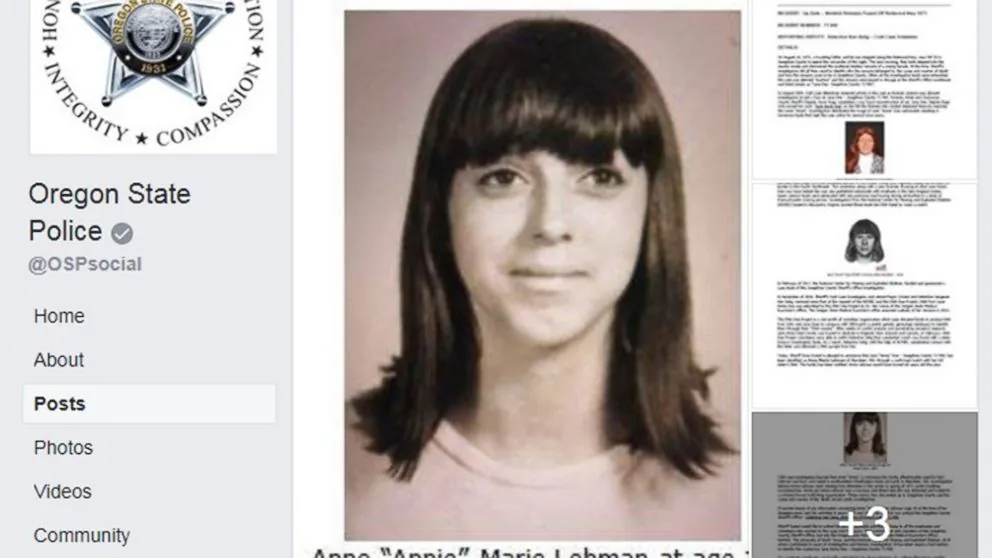
JOSEPHINE COUNTY, OR — A girl whose scattered remains were found in the woods of Josephine County in 1971 has finally been identified as Anne Marie Lehman, ending a mystery that lasted for decades. For years, investigators knew her only as Jane “Annie” Doe after a clay facial reconstruction was released in 2004 and a later forensic drawing was issued in 2016.
The breakthrough came through DNA and genetic genealogy, with the Josephine County Sheriff’s Office announcing Thursday that Lehman’s identity was confirmed after a volunteer network traced relatives and investigators obtained a DNA sample from a sister in Washington state. Lehman was 16 when she disappeared from Aberdeen, Washington, in 1971, and authorities now hope the identification will lead them closer to understanding what happened to her.
The case began in August 1971, when skeletal remains were discovered in the woods in Josephine County. The sheriff’s office said investigators eventually exhausted their early leads, and the case was later deemed inactive.
Even without a name, the girl remained a focus for local investigators. Over time, the remains became one of the county’s most enduring cold cases, with officers continuing to revisit the file as forensic methods improved.
The sheriff’s office said the remains were scattered, which made the investigation especially difficult from the start. Still, the discovery in Oregon set off a long effort to learn who the girl was and where she had come from.
In 2004, a deputy created a clay facial reconstruction of the unidentified girl and gave her the nickname Jane “Annie” Doe. The image was released publicly, drawing new leads, but none solved the case.
Investigators tried again in 2016 with forensic isotope analysis, a method that examines hair, teeth and bones to help estimate a person’s geographic background. That work suggested where Jane Doe may have lived, and officials released a new forensic drawing.
Authorities said the girl resembled a missing person from Massachusetts, but the similarity never produced a confirmed DNA match. The case still lacked the key evidence needed to connect the remains to a specific person.
The turning point came in late 2018, when the DNA Doe Project joined the effort. The nonprofit uses genetic genealogy to compare DNA from unidentified remains with profiles in public databases submitted voluntarily by users.
According to the sheriff’s office, Lehman’s DNA was badly degraded, which made matching her to relatives especially difficult. Even so, volunteers spent weeks working through ancestry clues and tracing possible family lines.
Officials said the family trail led to relatives in England, New Zealand and Canada. That research gave detectives a new path to follow, even though the identity still had not been confirmed at that stage.
The case moved from possible identification to confirmation in February, when DNA Doe Project volunteers found a potential match with a sister living in Washington state. Detectives contacted the woman and obtained a DNA sample, which confirmed the remains were Lehman’s.
The sheriff’s office said Anne Lehman of Aberdeen was 16 when she disappeared, likely in the winter or spring of 1971. Family members also said she was called Annie, which matched the nickname investigators had used for the unidentified girl for years.
For officials, the identification brought an answer that had been out of reach for nearly half a century. For the family, it marked the first real resolution in a case that had remained open in the minds of investigators long after it was set aside administratively.
Even with a name now attached to the remains, the most important questions remain unanswered. The Josephine County Sheriff’s Office said investigators are still working to determine how Lehman died and how she ended up in Josephine County.
Officials said some people have suggested she was a runaway, while others believe she may have been abducted and trafficked by a criminal organization. The sheriff’s office said those claims, along with the cause and manner of death, remain under investigation.
The office is asking anyone with information to come forward. Investigators say the identification is a major step, but it is not the end of the case.
Local and state officials credited the identification to persistence and new forensic tools. The sheriff’s office said forensic genetic genealogy is becoming one of the most powerful methods for solving cold cases that resisted earlier approaches.
It also said that without the DNA Doe Project’s work, it might have taken many more years to identify Annie Lehman and return her to her family. The Oregon State Police praised forensic anthropologist Dr. Nici Vance, calling her dedication and tenacity inspiring.
For investigators, the case stands as an example of how older evidence can gain new value when paired with modern science. After decades as Jane “Annie” Doe, the girl is once again known by her real name.