 111
 2
 3
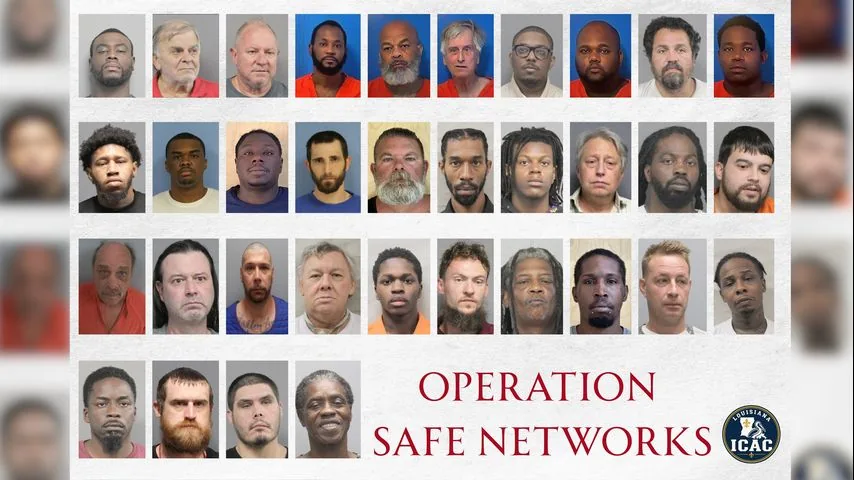
NEW ORLEANS, LA — Thirty-five people were arrested after a multi-month crackdown in southeast Louisiana that targeted registered sex offenders accused of illegally using social media and gaming platforms. Louisiana Attorney General Liz Murrill announced the results of Operation Safe Networks on Thursday with local, state and federal law enforcement partners.
The sweep focused on digital activity by people already subject to sex offender rules. Authorities said the investigation identified offenders using a wide range of online services, and some arrests also involved separate offenses uncovered during the operation.
Investigators said they uncovered offender activity across 16 major digital platforms, including Facebook, Instagram, Snapchat, TikTok, X, YouTube, WhatsApp, Telegram, Discord, PlayStation, Xbox, LinkedIn, Threads, Fambase, WhatNot and Zangi. The list shows how widely the operation reached across both social networks and gaming environments.
Murrill’s office said the effort was designed to find registered offenders who were using platforms they were not allowed to access. The announcement did not describe every case individually, but it said the online activity was the starting point for the broader arrests.
In addition to illegal social media use, authorities said some suspects were arrested for related crimes uncovered during the sweep. Those offenses included failure to register or to notify authorities as a sex offender or child predator, along with sexual abuse of animals.
The attorney general’s office said the operation was not limited to one kind of violation. Instead, investigators used the online activity to identify people who were also wanted on other allegations tied to sex offender compliance and public safety.
The operation involved 14 partner agencies, including the Louisiana Bureau of Investigation, Homeland Security Investigations, the U.S. Marshals Service and Louisiana State Police. Sheriff’s offices and police departments from Orleans, Jefferson, St. John the Baptist, St. Charles, St. Bernard and Plaquemines parishes also took part.
Officials framed the sweep as a coordinated response to online threats against children. Murrill said Louisiana law enforcement was taking the fight to people who threaten kids, and she urged parents to keep a close watch on their children’s devices.
The Louisiana ICAC Task Force has received more than 46,000 cyber tips so far this year, according to the attorney general’s office. Officials said those tips have helped lead to more than 600 arrests statewide, including 100 hands-on offenders.
The office also said the task force has helped rescue 80 children from ongoing abuse. Murrill used those numbers to argue that families should stay alert, saying parents should continue monitoring electronic devices and remember that parenting matters more than friendship when it comes to safety.
The attorney general’s release said 35 people were arrested, though it provided names and mugshots for 34 individuals. The office listed the following people as being arrested in the operation: James Antoine, Eugene Dimm, Tony Tesvich, Micah Stewart, Matthew Dixon, Craig James, David Alfred, Renarda Kirk, Dan Dolezal, Roosevelt Lee, Derrvon Hughes, Bernard Pharagood and Braxton Smith.
Also named were Jamel Brown, Timothy Lee, Thomas Clark, Timothy Nelson, Kenneth Ledet, Michael Simon, William McArthur, Darrell Restivo, A’mon Beasley, Justin Frierson, Vernon Sweeney, Nichollas Pla, Delery Brown, Darrell Brazile, Treyson Thedy, Tyronne Johnson, David Andrews, Raymond Jakubielski, David Hunter, Charles Emmit and Udraka Roberts-Bey.
Operation Safe Networks reflects how law enforcement agencies are increasingly watching social platforms, messaging apps and gaming services for signs of unlawful contact or prohibited access. The platforms named in the case span everyday communication tools as well as online spaces where children and teens spend time.
For parents, the attorney general’s office cast the operation as a reminder to check children’s online activity closely. Officials did not announce any change in law, but they said the investigation showed that offender conduct can spread across mainstream apps, gaming systems and lesser-known services alike.