 111
 2
 3
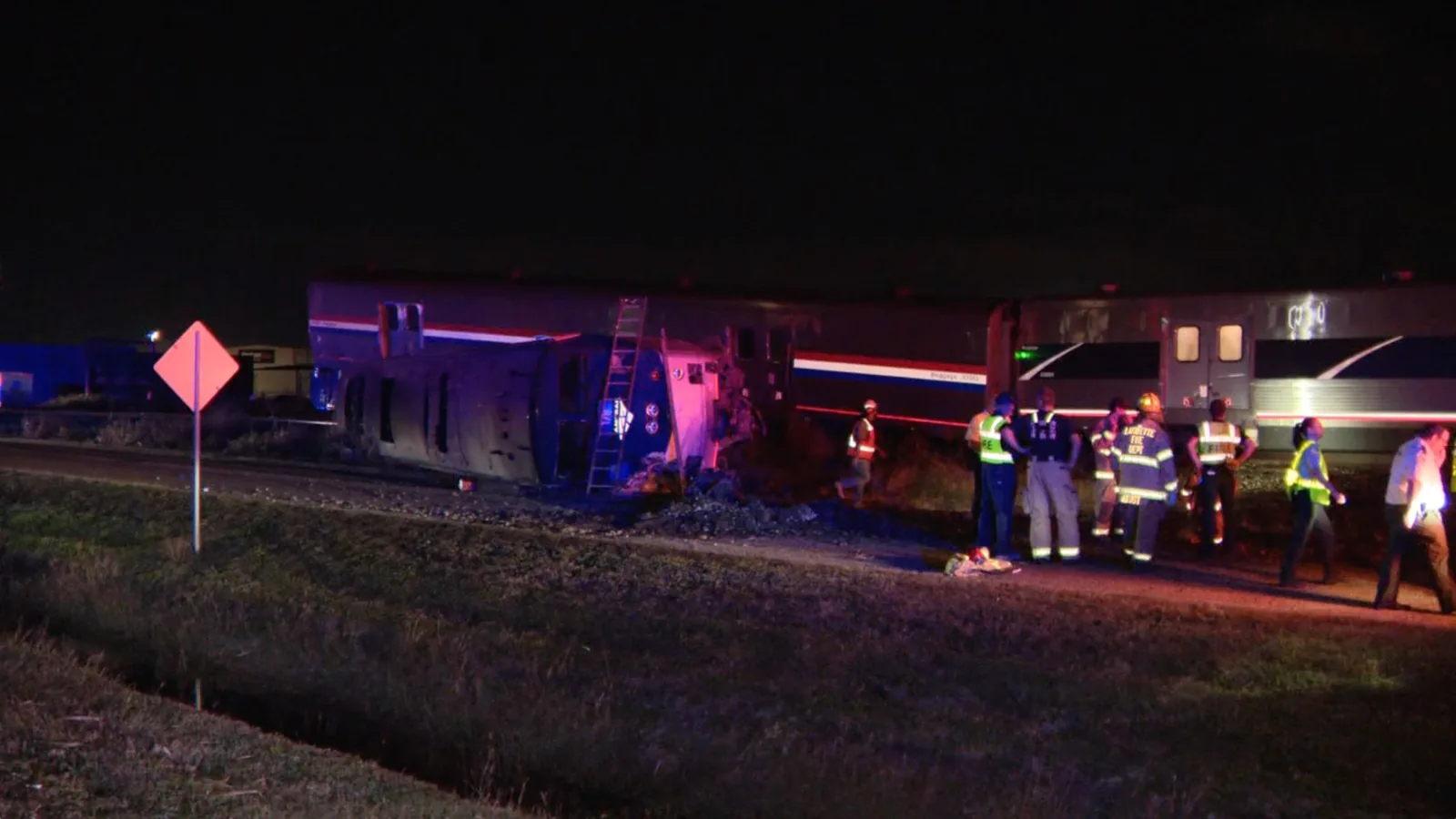
LAFAYETTE, LA — An Amtrak train with nearly 100 people aboard derailed in Louisiana on Sunday evening after hitting a tractor-trailer at a railroad crossing, sending four passengers to a hospital and leaving other riders to be checked at the scene.
Lafayette police said the collision happened around 6:05 p.m. and involved an 18-wheeler carrying a bulldozer. The impact knocked the train’s first two cars off the tracks, though the passenger cars stayed upright. Authorities said the injuries reported so far were not believed to be life-threatening.
Police said the tractor-trailer tried to cross the tracks and ended up stuck on them. Within minutes, the crossing arms came down as the train approached, but the train was still unable to stop before the crash.
Lafayette Police Sgt. Ashley Wood said the locomotive appeared to slow down before impact. The sequence suggests the crew had little time to avoid the collision once the truck was stranded on the crossing.
Investigators have not said yet why the 18-wheeler could not get off the tracks in time. That unanswered question is likely to be a major part of the crash review as officials work to determine how the sequence unfolded.
Of the 95 passengers on board, four were taken to an area hospital after the derailment, according to Acadiana News First. Police said those injuries were not considered life-threatening.
Other passengers who were hurt were treated at the scene by triage crews rather than being transported immediately. Authorities did not give a full count of how many people were injured in total, but they described the incident as involving multiple passengers.
The fact that only four people required hospital care suggests the outcome could have been far worse given the size of the train and the force of the collision.
Wood said the lead locomotive and two baggage cars derailed. All of the passenger cars remained upright, which helped limit the immediate danger to riders after the crash.
That detail also helps explain why the injuries were relatively limited despite the derailment. Even so, a train leaving the tracks can create serious risks from sudden movement, debris, and the possibility of secondary impacts.
Photos from the scene showed the damaged railcars after the collision, while emergency crews worked around the tracks and the crossing area.
Amtrak coordinated bus transportation for passengers after the derailment, police said. That allowed riders to leave the scene even as officials continued their response and the crash site remained under investigation.
The railroad company did not immediately provide additional details about the condition of the train or the timetable for restoring service in the area. For passengers, the immediate priority was getting everyone safely away from the crossing and accounting for anyone who might still need medical attention.
Emergency response at rail crashes often involves separating those with injuries from the larger group of passengers, then arranging alternate transportation once the scene is secure.
Burlington Northern Santa Fe responded to the scene to help investigate what happened. The railroad’s role is part of the wider effort to sort out the mechanics of the collision and the derailment.
So far, officials have not said what caused the truck to become stuck on the tracks, and they have not released a finding on whether any equipment problems, crossing conditions or driver actions contributed. Those details will matter as investigators piece together the chain of events.
The incident is a reminder of how quickly a railroad crossing can become dangerous when a vehicle is trapped in the path of an oncoming train. In this case, quick response appears to have prevented a more serious outcome.